Flagging & Communications Starter Guide
When starting out Trackside with Flagging & Communications, this guide will answer most of the questions a newby might have before they arrive at the track.
Trackside volunteers are all trained on the job, so don’t be concerned if you have more. They’ll all be answered once you arrive.
The Gear
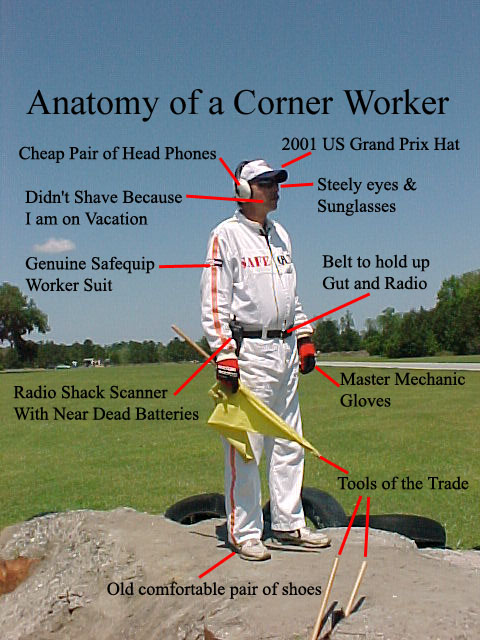
If you’re new to F&C, you’ll only need the basics when you arrive at the track. Here’s a list of what that includes:
- Appropriate full coverage white clothing. If you’re new, just wear neutral colors (avoid red, yellow, bright blue or black). No shorts 😊
- DURABLE rain gear (ex. Frogg Toggs or Columbia from a sporting goods store. Orange works well.)
- Hat, Sunglasses, Sunscreen
- Hearing Protection
- Comfortable Sturdy Waterproof Shoes
- Gloves (blaze or safety orange if you have them)
- Backpack, Bag, or Track Bucket to carry supplies, munchies, liquids, trinkets, etc.
Fully Equipped Gear
- Whistle (w/ break-away lanyard)
- Safety Glasses
- Rope (minimum 20′ length)
- Folding Chair
- Cutting Tool / Knife
- First Aid Kit / Kleenex
- Scanner w/ Headphones
- Binoculars
- Stopwatch
- Notepad & Pen / Pencil / Sharpie
- Duct Tape
What To Do on Station
An SCCA Trackside F&C worker on station serves as the primary, real-time communicator between race control and drivers, ensuring track safety through observation, signaling, and incident response. Flaggers operate in teams at designated corner stations, watching for debris, mechanical issues, or incidents, while relaying information via radio to officials and using flags to warn drivers. On a typical station, flaggers often work in pairs or teams to divide duties: one person monitors incoming traffic while another watches departing traffic and handles radio communications.
- Signaling Drivers: Using yellow, blue, or other flags to communicate hazards, debris, or overtaking vehicles to oncoming drivers.
- Observing and Reporting: Continuously monitoring the track for incidents, car debris, or fluid leaks and instantly reporting them to race control.
- Incident Response: Responding to accidents on the track to assist drivers and evaluate the scene, often using fire extinguishers and clearing debris.
- Radio Communication: Maintaining constant contact with the corner station chief and race control to provide updates on course conditions.
- Safety Maintenance: Ensuring a clear and safe course, and managing the flagger’s area by keeping spectators, photographers, and videographers in safe locations.
The Flags & What They Mean
- Green Flag: Racing is underway or the track is clear.
- Yellow Flag (Stationary): Danger ahead, slow down, and no passing.
- Local Yellow vs. Full Course Yellow: A local yellow applies only to a specific corner, while double-yellow flags at all stations indicate a full-course yellow (usually with a pace car).
- Yellow Flag (Waved): Great danger ahead, slow down, and be prepared to stop.
- Yellow/Red Stripe: Debris or fluid (oil, water, sand) on the track surface.
- Blue with Yellow/Orange Slash: A faster car is trying to overtake you.
- White Flag: A slow-moving vehicle (ambulance, tow truck, or damaged car) is on the track. The white flag can also be displayed on the last lap from the starter.
- Black Flag (Closed/Pointed): Warning for dangerous driving.
- Black Flag (Open): Return to the pit area immediately for consultation.
- Black Flag with Orange Disk (Meatball): Mechanical failure, return to pits.
- Red Flag: Extreme danger; stop racing immediately and come to a controlled stop on the side of the track.
- Checkered Flag: The session (race, qualifying) has finished.
Basic Radio & Reporting Protocols
- Clear, Concise, Consistent: Report incident location (e.g., “Station 5, Turn 2”), vehicle number, color, type, and status of the car/driver (e.g., “spun off track and continued,” “contacted car XX, side-to-side, both cars continued”).
- Priorities: 1. Yourself (Safety), 2. Buddies (Team), 3. Drivers.
- Information Flow: Constantly relay updates from the track to Race Control, and relay instructions from officials to drivers.
- Hand Signals: Used to communicate directly with drivers or other workers when flags are not enough, such as verifying that a driver is ok, or what type of response vehicle is need (e.g. a flat tow or a wrecker.)
- Number Boards: Paired with black flags to display which driver must enter the pits.
Minors and F&C
Minors age 14 and above are welcome to join our SCCA teams Trackside – with a few exceptions. Due to some state laws, certain tracks require all persons in “hot” areas to be over 18. Check with our F&C Chief beforehand. Here is our quick Minors Guide.